
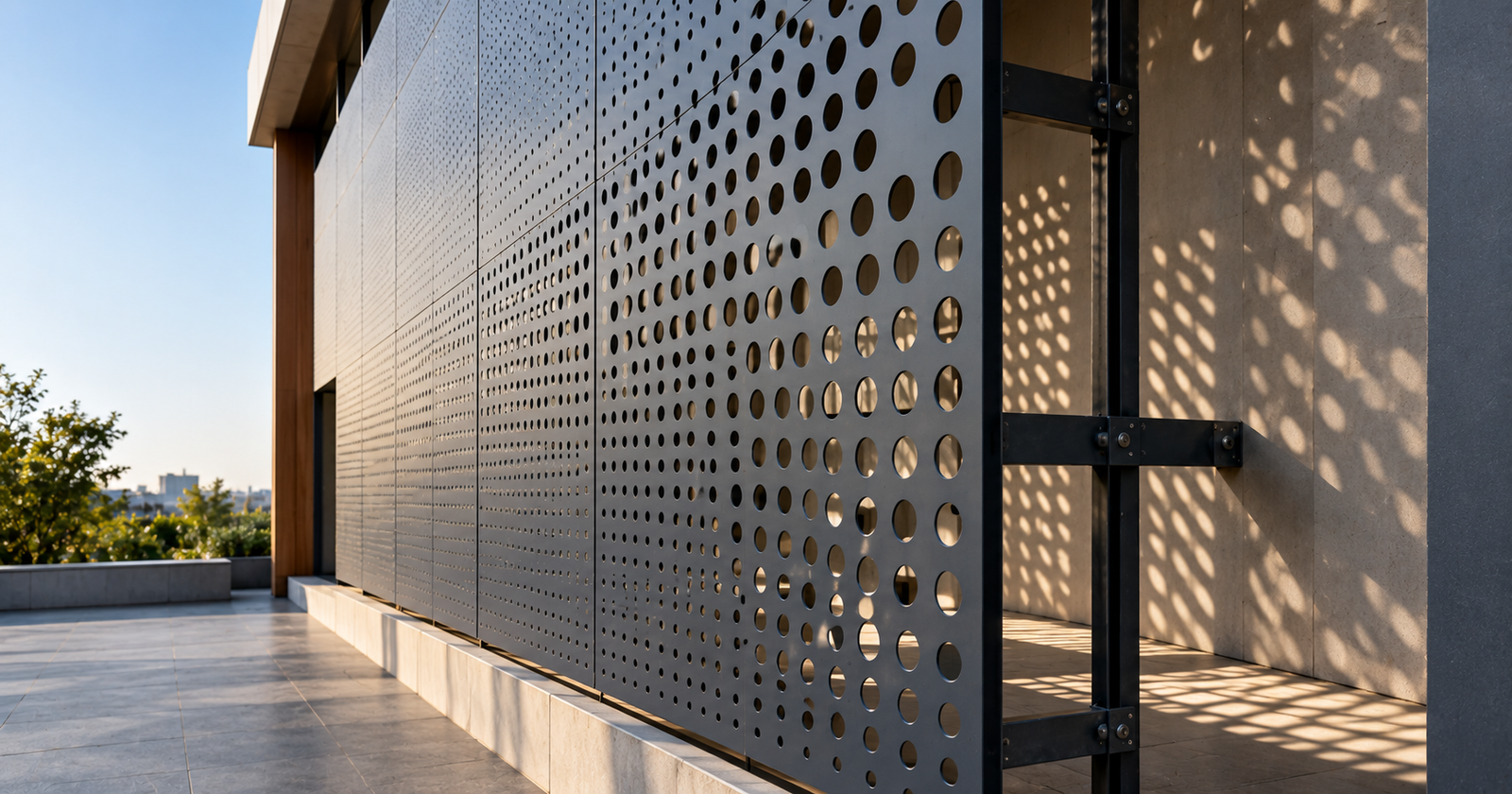
Perforated and parametric panelling is one of the defining directions in facade design right now, and HPL is well suited to it because compact panels can be CNC-cut cleanly without edge delamination. The design possibilities are wide. The constraints — structural, cost and maintenance — are where projects need to be realistic early.
Why HPL Works for This
Compact HPL is a solid, homogeneous panel rather than a laminate bonded to a core. Cut it and the exposed edge is the same cured material throughout, so a CNC-routed hole does not expose a vulnerable substrate the way a composite panel would.
That makes complex cutting viable without an elaborate edge-sealing exercise around every perforation, which would otherwise make the approach uneconomic.
What These Facades Are Used For
- Solar shading — a perforated screen set in front of glazing cuts direct gain while preserving daylight and outward view. This is the most defensible functional use in Indian conditions.
- Privacy screening — balconies, corridors and stairwells that need to breathe without being fully exposed
- Parking and service screening — concealing structures that need ventilation
- Identity and pattern — gradient perforation and parametric patterning as the building’s visual signature
- Ventilation with enclosure — plant rooms, substations, service cores
Design Parameters That Matter
Open area percentage
The single most consequential number. It governs shading performance, view through, airflow and — critically — how much panel material remains to carry load. High open area looks dramatic and weakens the panel.
Thickness
Perforation removes material, so perforated panels generally need greater thickness than solid panels of the same size. This is not optional; an under-thickness perforated panel will deflect and can fail at the ligaments between holes.
Ligament width
The remaining material between adjacent holes. Narrow ligaments look elegant and concentrate stress. This is where perforated panels fail when they fail.
Edge margins
Perforations must stop short of panel edges and fixing points. Running the pattern into the edge compromises exactly the zones that carry the fixings.
Pattern continuity across panels
For a parametric pattern to read as one surface, the pattern must align across panel joints. That requires panel-by-panel fabrication data rather than a single repeated tile, which changes both the design workflow and the cost.
Cost Reality
Before design is locked, it is worth sending the pattern to your panel manufacturer for a feasibility view. At HPL Maker this is a routine conversation, and it usually saves a redesign later when open area or ligament width turns out to be unbuildable at the intended thickness.
Perforated and parametric panels cost substantially more than plain panels. The drivers:
- CNC machining time, which scales with hole count rather than panel area
- Greater thickness to compensate for removed material
- Panel-specific fabrication files where the pattern varies
- Higher material wastage
- Slower installation, since panels are orientation-specific and cannot be swapped freely
The practical approach on most budgets is to use perforation selectively — a screen element, an entrance feature, a stair tower — against plain panels elsewhere. A fully perforated building envelope is a large commitment.
Constraints to Plan For
Cleaning. A perforated screen collects dust, leaves and debris in every hole, and it cannot be wiped. In dusty Indian cities this is a real maintenance consideration. Plan access for washing down, and be honest with the client about what the screen will look like in year three without it.
Birds and insects. Larger perforations and the cavity behind them invite nesting. Mesh backing or sizing the perforations below a threshold prevents it.
What is behind matters. A perforated screen reveals whatever sits behind it. If that is an unfinished wall, service pipework or stained concrete, the screen frames it rather than hiding it. Specify the backdrop deliberately.
Night appearance. Perforated screens behave inversely after dark — light escapes through the holes, and the pattern reads as illuminated rather than shadowed. This can be the best thing about the facade if planned, or an unpleasant surprise if not.
Replacement. An orientation-specific panel in a parametric pattern cannot be replaced from generic stock. Hold spares from the original fabrication run.
Frequently Asked Questions
Can HPL panels be perforated?
Yes. Compact HPL is homogeneous throughout, so CNC perforation produces clean edges without exposing a vulnerable core.
What thickness is needed for perforated HPL?
Greater than for a solid panel of the same size, with the exact figure driven by open area percentage, ligament width, panel dimensions and wind load. This needs calculation, not assumption.
How much more does a perforated facade cost?
Substantially more — driven by machining time, increased thickness, panel-specific fabrication and slower installation. Selective use on feature elements is the usual way to make it viable.
How are perforated screens cleaned?
Washing down rather than wiping, with access planned from the outset. Dust accumulation in perforations is a genuine maintenance consideration in Indian cities.
Exploring a perforated or parametric facade? Contact HPL Maker to discuss panel thickness, fabrication and feasibility for your design.